
HDH - Humanidades Digitales Hispánicas
  • Link to X
  • Link to Mail
  • Inicio
  • La asociación
    • Estatutos
    • Organización
    • Documentos
    • Informes
    • Comunicación y difusión
    • Imagen corporativa
  • Congresos
  • Actividades
    • Café con
    • Compartir pantalla
    • Lectura en digital
  • Convocatorias
    • Ayudas y subvenciones
    • Premios HDH
    • Premio tesis HDH-FBBVA
  • Noticias
  • Recursos
    • Listado de recursos
    • Formación
    • Textos HD
  • Socios
    • Afiliación de socios
    • Espacio de socios
    • Solicita el apoyo de la HDH
  • Contribuciones
  • Contacto
  • Click to open the search input field Click to open the search input field Buscar
  • Menú Menú

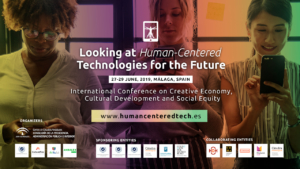
Looking at Human-Centered Tecnhologies for the Future. International Conference on Creative Economy, Cultural Development and Social Equity

Málaga, 27-28 de junio de 2019

Colección del Museo Ruso de San Petersburgo

Organiza Universidad de Málaga, Universidad de Western Ontario (Canadá), Centro de Estudios Andaluces de la Junta de Andalucía.

http://humancenteredtech.es 

The current public policies of economic and social development point to the important role that artistic creation, creative industries and cultural institutions play in the new productive models due to their capacity of catalyzing wealth, quality of life and social prosperity.  The Creative Economy Report2013 by UNESCO and the UNDP (United Nations Development Program) emphasized this idea meanwhile calling for the implementation of initiatives that stimulated innovation in this field, in the search for sustainable, equitable and inclusive growth and development.

The creative economy “includes the sectors in which the value of their goods and services is based on intellectual property: architecture, visual and performing arts, crafts, cinema, design, publishing, research and development, games and toys, fashion, music , advertising, software, TV and radio, and video games» (Orange Book of the Creative Economy, BID). In 2005, this economic sector reached 6.1{6492360ee5b0fb3b1074343ac227414b1d4a968c43703d1c9a8a61a137798d5d} of the global economy and reached 4.3 billion dollars in 2011. According to the aforementioned IDB report, exports of creative goods and services in 2011 reached $ 646 billion dollars.

In The Rise of the Creative Class(2002), Richard Florida (Director of the Martin Prosperity Institute of the Rotman School of Business at the University of Toronto) also highlighted the importance of diversity and creativity in the rise of innovation and regional and national growth. Florida postulates that creative capital, that is, the human capital contributed by the creative class, is a key factor for the economic growth and social welfare of cities. This creative class includes: scientists and engineers, teachers, poets and novelists, actors, designers and architects, as well as cultural agents, artists, think-tank analysts and opinion makers.

To this approach brought about by the creative economy, it must be added the possibilities that current technological developments, such as those associated to Data Science and Artificial Intelligence, offer to extract strategic knowledge (descriptive and prospective) about the reality (social, economic, cultural) that is being analyzed. For example, the production and design of multivariable and multiscale indicators facilitated by these technologies are of great utility in the planning and evaluation of cultural and social policies. Likewise, knowledge generation from citizens is becoming both more feasible as well as important. Data provided directly by individuals can be critical as it can add information beyond what is available otherwise.

However, the conditions of an ever-increasing technological society, the growing overflow of data, its expanding role as social, economic and political tools, as well as certain non-transparent and suspicious practices related to data extractivism and reusability logics bring to light challenging uncertainties that involve global ethical and right issues that cannot be displaced from the conversation.

Certainly, if our final purpose is to build a new world more balanced, equitable and respectful with the people and the environment they inhabit for a future that we venture more and more hyper-technological, a human-being centered technology approach is needed to promote initiatives that explore solutions for the most society’s pressing challenges without losing sight of individual and collective rights to privacy, diversity, inclusiveness and freedom.

According to this complex scenario, the objectives of this international conference are, in the first place, to analyze how current technological innovations and the frameworks of thought that they generate are capable of promoting processes of cultural development, economic growth, social inclusion and equity. Secondly, to examine the challenges that must be faced at a global level in an increasingly datacentric, hyperconnected and technological society, especially those that involve issues related to human rights and legal responsibilities, democratic representation and governance systems. Thirdly, this conference also aims to discuss the ways in which research activities, private initiatives, public policies, economic investments, etc. should be channeled in the coming years to achieve a better future for all.

Within the framework of this conference, the results of the project Data methodologies applied to the analysis of artistic exhibitions for the development of the creative economy (Andalex Project) will be presented and discussed. Andalex Project focuses the attention on the cultural subsector of art exhibitions under the premise that exhibitions represent a key component of the creative economy since they constitute a first-order element in the generation of socio-cultural and economic dynamics in the territories; and in the valuation of creativity as an expression of territorial and cultural diversity.

This conference aims to bring together researchers, experts, practitioners, technologists, activists, students, executives, entrepreneurs, policymakers, and all of them interested in this fascinating area of research, criticism and action.

Buscar

Search Search

Entradas recientes

  • Compartir Pantalla con Andrea Carcelén Guerrero. 12 de mayo de 2026 mayo 5, 2026
  • El VIII Congreso de la HDH se celebrará en San Cristóbal de La Laguna del 26 al 28 de octubre de 2027 mayo 4, 2026
  • Fallado el V Premio a la Mejor Tesis Doctoral en Humanidades Digitales 2025 HDH-FBBVA abril 30, 2026
  • Convocatoria de los Premios HDH 2026 marzo 26, 2026

Nube de Tags

3D (2) análisis de redes (5) Archivística (2) Arqueología (2) Arte (1) CfP (12) ciencia abierta (3) ciencia ciudadana (1) CLARIAH (3) CLARIN (2) DARIAH (4) Digital Art History (2) Divulgación (3) Edición digital (9) Educación (5) Elecciones (5) epigrafía (1) estilometría (1) Estudios literarios (7) Filología (4) formación (1) fotogrametría (2) Historia (3) Historia del Arte Digital (9) Identidades culturales (2) Inteligencia Artificial (7) investigación (2) Linked Open Data (2) Modelos 3D (2) Multilingüismo (2) Museos (3) musicología (1) Máster (2) ontologías (1) Patrimonio Digital (6) PLN (2) Postdoctorado (4) Realidad Virtual (2) SIG (4) Sociolingüística (1) Socios (5) teatro (4) Teoría HD (5) TIG (2) XML-TEI (5)

Categorías

  • Actividades (12)
  • Actividades con patrocinio HDH (11)
  • Actividades con respaldo HDH (2)
  • Actividades de socios (20)
  • Ayudas HDH (14)
  • Café con (34)
  • Compartir pantalla (12)
  • Convocatorias (6)
  • Eventos académicos (79)
  • Formación (21)
  • Lectura en digital (6)
  • Noticias de la HDH (43)
  • Noticias HD (6)
  • Premio tesis HDH-FBBVA (14)
  • Premio TFG y TFM – HDH-UNIR (1)
  • Premios HDH (16)
  • Publicaciones (15)
  • Recursos (3)
  • Trabajo (6)
  • Uncategorized (2)

Asociación académica sin fines de lucro, inscrita en el Registro Nacional de Asociaciones de España desde el 28 de agosto de 2012 con el número 600632.

Últimas noticias

  • El VIII Congreso de la HDH se celebrará en San Cristóbal de La Laguna del 26 al 28 de octubre de 2027
  • Fallado el V Premio a la Mejor Tesis Doctoral en Humanidades Digitales 2025 HDH-FBBVA
  • Convocatoria de los Premios HDH 2026
  • La HDH y la Fundación BBVA entregan el IV Premio a la Mejor Tesis Doctoral en Humanidades Digitales

Congresos HDH

  • Congreso HDH 2025
  • Congreso HDH 2023
  • Congreso HDH 2021
  • Congreso HDH 2019
  • Congreso HDH 2017

HDH en X (Twitter)

Tweets por HDH
© Humanidades Digitales Hispánicas | By ONOKY
  • Link to X
  • Link to Mail
  • Política de Privacidad
  • Contacto
Link to: Seminario «Investigación y Humanidades digitales: por qué, cómo y para qué» Link to: Seminario «Investigación y Humanidades digitales: por qué, cómo y para qué» Seminario «Investigación y Humanidades digitales: por qué, cómo y para ... Link to: Resolución de la I Edición de los Premios HDH (#PremiosHDH2018) Link to: Resolución de la I Edición de los Premios HDH (#PremiosHDH2018) Resolución de la I Edición de los Premios HDH (#PremiosHDH2018)
Desplazarse hacia arriba Desplazarse hacia arriba Desplazarse hacia arriba

Utilizamos cookies propias para el correcto funcionamiento de la página web, de todos sus servicios, y de terceros para analizar el tráfico en nuestra página web. Si continúa navegando, consideramos que acepta su uso. Puede cambiar la configuración u obtener más información.

OKLea nuestras políticas

Políticas de Cookies y de Privacidad


Cómo usamos las cookies

Podemos solicitar que se configuren cookies en su dispositivo. Utilizamos cookies para informarnos cuando visita nuestros sitios web, cómo interactúa con nosotros, para enriquecer su experiencia de usuario y para personalizar su relación con nuestro sitio web.
Haga clic en los diferentes encabezados de categoría para obtener más información. También puede cambiar algunas de sus preferencias. Tenga en cuenta que el bloqueo de algunos tipos de cookies puede afectar su experiencia en nuestros sitios web y los servicios que podemos ofrecer.

Cookies de sitios web esenciales

Estas cookies son estrictamente necesarias para proporcionarle los servicios disponibles a través de nuestro sitio web y para usar algunas de sus funciones.
Debido a que estas cookies son estrictamente necesarias para entregar el sitio web, no puede rechazarlas sin afectar el funcionamiento de nuestro sitio. Puede bloquearlos o eliminarlos cambiando la configuración de su navegador y forzar el bloqueo de todas las cookies en este sitio web.

Cookies de Google Analytics

Estas cookies recopilan información que se utiliza de forma agregada para ayudarnos a comprender cómo se utiliza nuestro sitio web o qué tan efectivas son nuestras campañas de marketing, o para ayudarnos a personalizar nuestro sitio web y la aplicación para mejorar su experiencia.
Si no desea que rastreamos a su visitante a nuestro sitio, puede deshabilitar el seguimiento en su navegador aquí:

Otros servicios externos

También utilizamos diferentes servicios externos como Google Webfonts, Google Maps y proveedores externos de video. Dado que estos proveedores pueden recopilar datos personales, como su dirección IP, le permitimos bloquearlos aquí. Tenga en cuenta que esto puede reducir en gran medida la funcionalidad y la apariencia de nuestro sitio. Los cambios tendrán efecto una vez que recargues la página.

Configuración de Google Webfont:

Configuración de Google Map:

Incrustaciones de videos de Vimeo y Youtube:

Política de privacidad

Puede leer nuestra política de privacidad en detalle en nuestra Página de Política de Privacidad.

Política de Privacidad
Accept settingsHide notification only